archived · Fabrication
DIY Snowskate from a Kids' Ski
Built a functional snowskate from a thrifted kids' ski, a plastic skateboard deck, and waterjet-cut aluminum trucks I designed in CAD.
- SolidWorks
- Waterjet
- Sheet Metal
- Design for Manufacturing
- Prototyping
The build
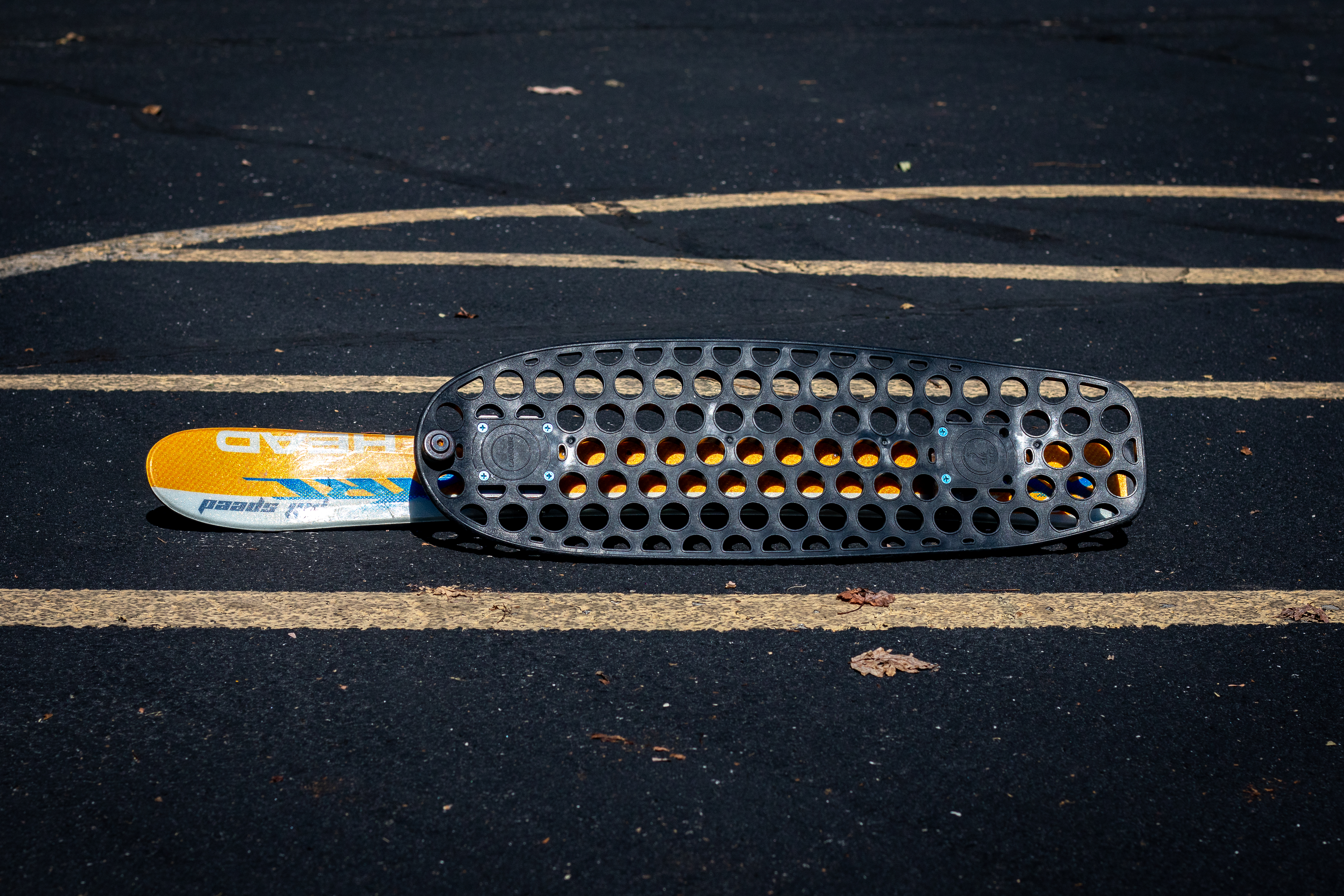
I built this snowskate from a kids’ ski I thrifted and a plastic skateboard deck. The interface between the two, a pair of rocker mounting trucks I designed in CAD specifically for waterjet cutting.
The design had to solve a few problems at once:
- Match two curved surfaces. A ski is cambered; a skateboard deck is flat. The mounting plates had to bridge that gap without introducing stress concentrations that would crack the plastic deck. I drew inspiration from a pivot and rocker style design. The front truck pivots only where it meets the ski. The rear truck has pivots on both the deck side and the ski side. This three bar pivot mechanism allows the ski to flex under the weight of the rider and to bend arround depresions and hills in the terrain. Carving charecteristics on skis and snowboards require the weight of the skier or boarder to bend the ski against the camber until the edge contacts the point along a single curve.
- Survive impact. Snowskates take a beating, hard landings, rail hits, icy patches. Everything had to be overbuilt enough to handle that. Using oil-impregnated bronze bushings in the pivots allowed me to acvhieve tight tolerances with nearly no slop or play in the pivots, which allowed rider feedback and controll authority to transmit though the trucks and into the ski.
- Be manufacturable in one pass. Waterjet is a 2D process. Every feature from mounting holes, and contours had to fit on a flat sheet.
Learning to ride it
I had so much fun learning how to ride this thing, falling on my butt many times but getting back on. By the end of the first trip I got the hang of it and was able to get on and ride off the chairlift.
Once you understand the balance and weight distribution, it behaves a lot like a snowboard. The foot placement is narrower and the platform is shorter, so the response is twitchier, but the fundamentals are the same in terms of edge controll, weight balance, and turn commitment.
What I learned
- Design for a specific process. Waterjet is subtractive 2D I wanted to add waterjet cutting to my list of familiar fabrication methods. Drawing inspiration from traditional no-glue woodworking techniques, I used a tenon and mortise style joint for rigidity.
- Physical prototyping teaches faster than simulation. I had no idea if this would even be ridable, I asked the snowskate community on Reddit but they seemed pretty sure that my ski was going to be too short and narrow to ride. Already having the ski and the parts, I decided to pull the trigger and it turned out to be a lot of fun.
- Iteration through failure. Every fall was feedback. By the end of the first trip, my balance had adapted to the platform, that wouldn’t have happened without committing to ride it badly for a few hours first.